
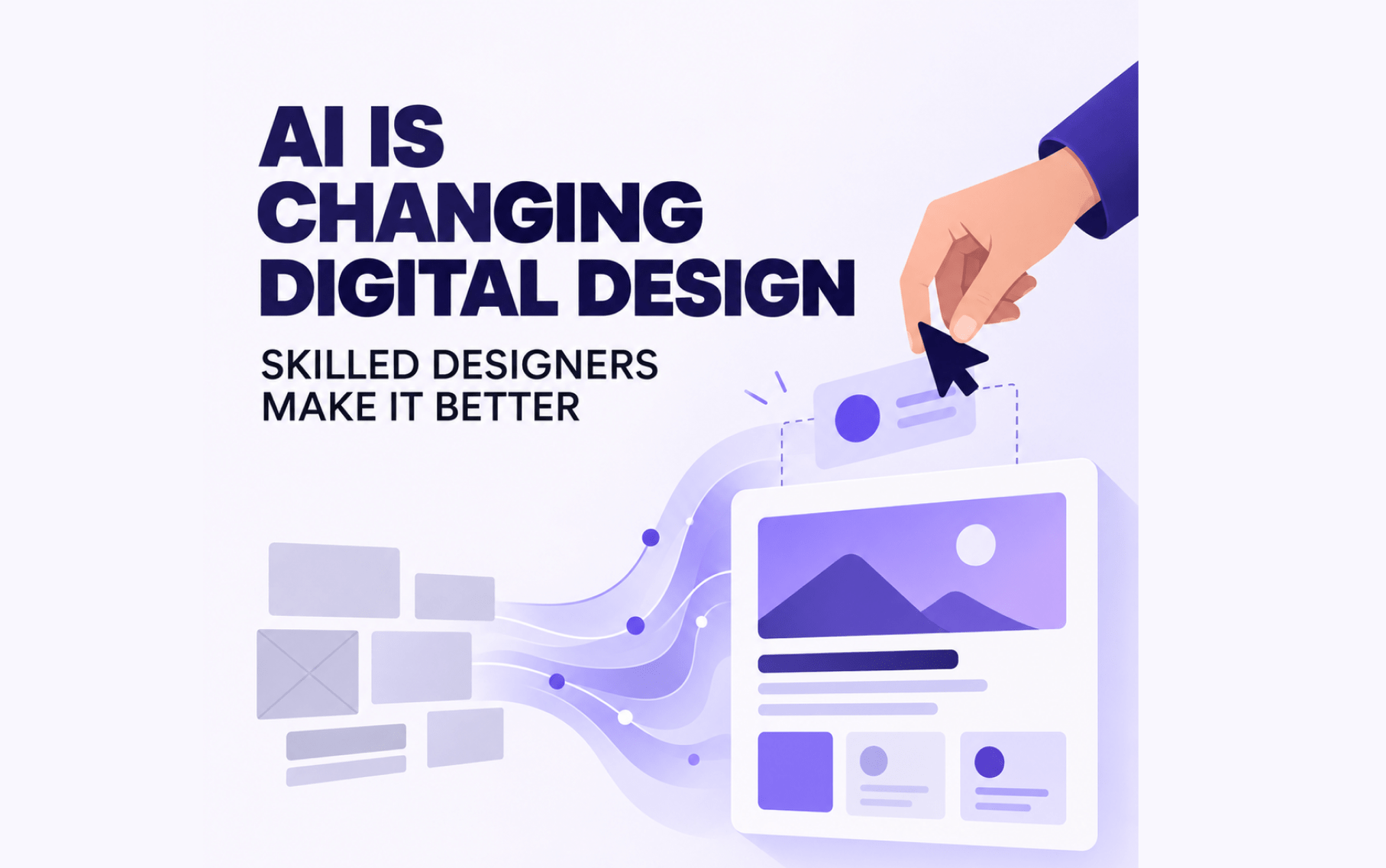
AI is accelerating digital creation. In the hands of trained graphic designers and UX designers, that speed becomes better thinking, stronger brands and more valuable customer experiences.
Artificial intelligence is changing how digital and marketing assets are conceived, produced and improved. Ideas that once took days to visualise can now take hours. Early concepts can be explored at greater scale, content can be adapted more quickly and teams can test more possibilities before committing to a direction.
This is not a threat to good design. It is an opportunity to raise the standard of it.
AI can generate options at remarkable speed. Skilled designers turn those options into deliberate, useful and distinctive experiences. They understand what the work needs to achieve, who it needs to serve and how every decision should support the organisation behind it. When AI and professional design expertise work together, faster production becomes a force multiplier for better outcomes.
AI is changing the economics of production
For digital teams, AI is removing friction from many parts of the production process. It can help generate initial directions, explore variations, draft content, create imagery, prototype interfaces and adapt assets for different formats. It can also make iteration more practical, because producing another version no longer carries the same cost or delay.
That shift matters. Teams can explore a broader range of ideas, respond to feedback sooner and spend less time on repetitive production. Smaller organisations can access capabilities that were once beyond their budgets, while larger organisations can move more quickly across complex digital ecosystems.
But greater production capacity creates a new challenge: more output does not automatically mean better output. When it becomes easy to create dozens of options, the quality of the decisions behind them matters even more. The question is no longer only whether something can be made. It is whether it is the right thing to make, and whether it will work.
Why trained graphic designers add value
Graphic design is not simply the production of attractive visuals. It is the disciplined use of typography, composition, colour, imagery, hierarchy and space to communicate clearly and shape how a brand is experienced.
A trained graphic designer can assess an AI generated concept and see what a general user may not. They can identify weak hierarchy, inconsistent spacing, poor typography, off brand imagery, visual noise or a composition that looks polished but directs attention to the wrong place. They know when to refine an idea, when to combine elements and when to discard an option entirely.
This judgement protects brand consistency across websites, campaigns, social content, presentations and printed materials. It also creates distinction. AI can draw from familiar patterns, but a designer can ensure the final result reflects the organisation’s identity rather than settling for something merely competent or recognisable.
The value is not in manually producing every pixel. It is in making informed choices that help the right message land with the right audience.
Why UX designers matter
UX design addresses a different but closely related question: can people understand and use the experience easily?
AI can propose a page layout, navigation structure or user flow. A UX designer tests whether that structure makes sense for the people who will rely on it. They consider user needs, information architecture, task flows, interaction patterns, content order and the context in which the experience will be used.
This is especially important when a website or digital product needs to support complex decisions, serve diverse audiences or guide people through high value actions. A plausible interface can still create confusion, hide essential information or place unnecessary barriers between a user and their goal.
Trained UX designers bring research, testing and evidence into the process. They challenge assumptions, identify usability problems and design for accessibility from the outset. That improves experiences for people with disability and frequently makes the product clearer for everyone. It also reduces the risk of investing in features or content that users do not need.
AI increases the leverage of skilled designers
The strongest use of AI is not to remove expertise from the process. It is to give experts more reach.
With AI supporting exploration and routine production, designers can compare more directions, prototype earlier and test ideas before they become expensive to change. They can spend more time on the work that requires judgement: defining the problem, understanding the audience, setting creative direction, improving the user journey and making the final experience coherent.
This changes the designer’s role from producer alone to director, curator and strategic partner. A skilled designer can use AI to move faster without surrendering accountability for the outcome. They know how to brief the tools, evaluate what comes back and improve it with intent.
The result is not human creativity versus machine capability. It is professional expertise amplified by faster ways to explore, make and learn.
Professional design protects digital and marketing investment
Digital and marketing assets are business investments. A website may need to generate enquiries, explain a complex service, support customers, attract talent or build trust. A campaign may need to change behaviour, reach a new audience or strengthen a brand over time.
If the design is unclear, inconsistent or difficult to use, the organisation pays twice: first for the asset, then through missed opportunities, rework, customer frustration or damage to credibility. Fast production does not offset those costs.
Professional design improves the return on investment by connecting execution to purpose. Graphic designers ensure the brand appears credible, consistent and distinctive. UX designers ensure people can find information, complete tasks and move through the experience with confidence. Accessibility thinking broadens reach and reduces avoidable exclusion. Usability testing surfaces problems while they are still easier to fix.
AI can make each of these activities faster. Skilled professionals ensure the speed is applied to the right priorities.
OSKY’s approach to human and AI
At OSKY, we see AI as an important part of the modern digital toolkit. We use it to accelerate exploration, support prototyping, improve workflows and create more room for valuable thinking. We also recognise that every tool is only as effective as the decisions that guide it.
Our designers combine emerging AI capabilities with established expertise in brand, visual communication, UX, accessibility and digital delivery. We start with the organisation’s goals and the needs of its users. We then use the most appropriate tools to explore, test and refine a solution that is fit for purpose.
This approach gives clients the benefits of speed without compromising clarity, quality or accountability. It keeps people at the centre of the experience while allowing teams to make better use of new technology.
AI is expanding what is possible in digital design. The organisations that gain the most from it will not be those that generate the most content. They will be those that combine the technology with skilled people, clear strategy and the confidence to make strong decisions.
Build faster and design with purpose
Planning a new website, digital product or campaign? Talk to OSKY about combining AI enabled production with professional graphic design and UX expertise to create work that is clear, accessible, distinctive and built to perform.
