
A finished website, web application or mobile app can look simple from the outside.
That simplicity is often the result of a great deal of careful work behind the scenes.
When organisations turn to OSKY to deliver a digital product, they are not just engaging a team to design screens and write code. They are engaging a delivery process designed to make the product reliable, secure, maintainable and capable of evolving over time.
It starts with understanding the problem
Before development begins, we need to understand what we are actually trying to solve.
That means understanding the organisation, its users, the goals of the project and the environment in which the product will operate.
Depending on the project, this can involve questions such as:
- Who are the users and what are they trying to achieve?
- What information and functionality do they need?
- What business processes need to be supported?
- What existing systems need to integrate with the new platform?
- What accessibility requirements need to be considered?
- What security and privacy obligations apply?
- How will the product be maintained after launch?
- How is it likely to evolve over the next several years?
These decisions influence everything that follows.
From there, our team can work through user experience, information architecture, interface design, technical architecture, integrations and the development approach.
A structured engineering workflow
Once development begins, the work behind the screen becomes just as important as the interface itself.
OSKY uses a structured engineering workflow so changes can be developed, reviewed, tested and released in a controlled way.
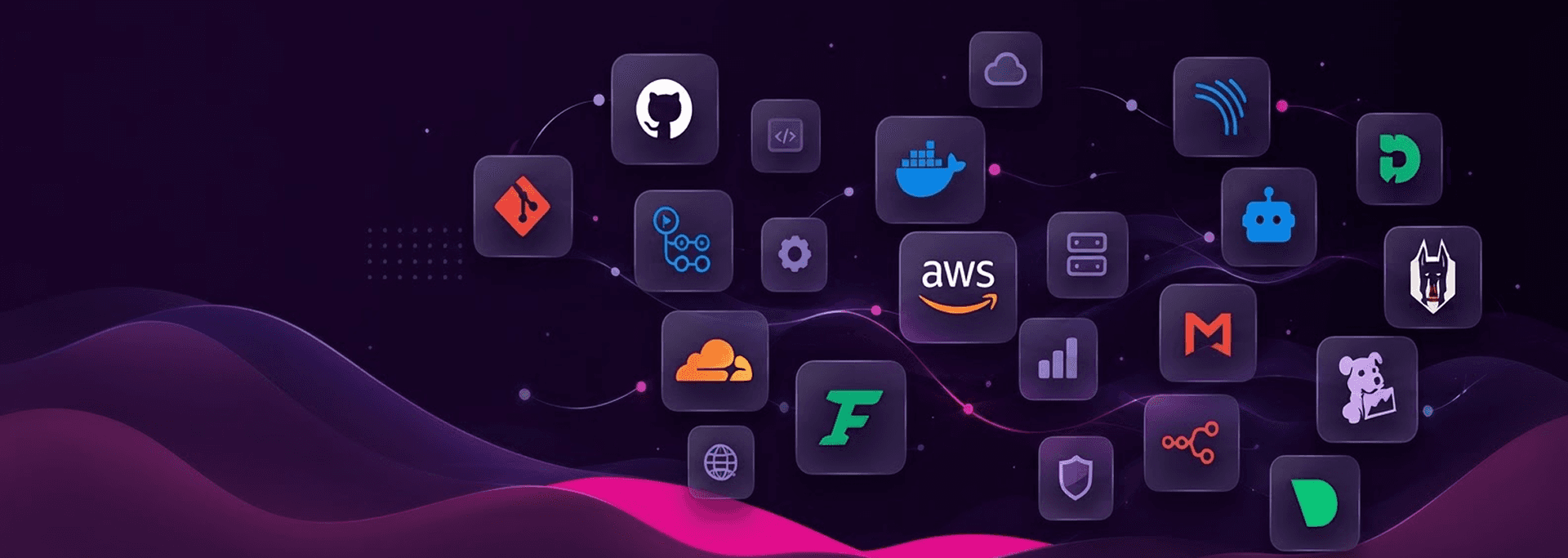
Our core delivery stack includes tools such as:
- Git for version control and maintaining a complete history of changes
- GitHub for code repositories, collaboration and review
- GitHub Actions for automating builds and deployments
- Docker where containerisation helps create consistent application environments
- Laravel Forge for server provisioning and management
- AWS for cloud infrastructure, databases, storage and supporting services
- Cloudflare for performance, security and edge services
- n8n for workflow and process automation
- Netdata for system and application monitoring
The exact tools vary from project to project.
The underlying principles do not.
Development should be controlled and traceable
Version control allows our developers to work collaboratively while maintaining a clear record of every change made to a codebase.
Code can be reviewed before it is merged. Changes can be traced. Previous versions can be referenced when necessary.
For clients, most of this happens invisibly, but it creates an important layer of discipline around the development process.
Development and production should not be the same place
New functionality should not simply be developed directly on a live system.
We typically work across separate development, staging and production environments so changes can be built and tested before they are released to real users.
This gives our team an opportunity to identify issues and refine functionality without unnecessarily affecting the live product.
Releases should be repeatable
Modern digital products change continually.
New functionality is released. Security patches are applied. Bugs are fixed. Integrations evolve.
Tools such as GitHub Actions allow us to automate parts of the build and deployment process so releases follow a consistent and repeatable workflow.
Reducing unnecessary manual steps also reduces the opportunity for human error.
Infrastructure matters too
A digital product does not exist in isolation.
Behind it are servers, databases, storage, networks, domain configuration, security controls and numerous supporting services.
OSKY works with platforms such as AWS, Cloudflare and Laravel Forge to manage the infrastructure that supports the applications we build.
For example, our AWS environments may use services such as Lightsail, S3, RDS and SES depending on the requirements of a project.
Cloudflare can provide additional performance, security and edge capabilities through services such as Workers, Pages, R2, D1 and Access.
The architecture is selected according to the needs of the product rather than forcing every project into the same technology stack.
More complex projects need additional assurance
Some projects carry greater operational, security or compliance requirements.
For these projects, the delivery process may include additional layers of automated testing, code analysis, security scanning, dependency monitoring, test management and application observability.
On projects such as the Vinnies NOD platform, our team has used tools including:
- SonarQube for code quality and security analysis
- DeepSource for automated static code analysis
- Dependabot for monitoring software dependencies
- Snyk for security scanning
- TestMonitor for managing structured testing and quality assurance
- Datadog for application and infrastructure monitoring and observability
Not every project requires every tool.
The level of engineering assurance should reflect the complexity, risk and importance of the system being built.
Quality assurance is part of delivery, not an afterthought
Before a product is released, there is another important phase of work.
Our teams review and test functionality, interfaces, responsive behaviour and integrations.
Depending on the project, this can include:
- functional testing
- quality assurance
- accessibility review
- browser and device testing
- performance optimisation
- security checks
- content review
- deployment verification
The goal is not simply to demonstrate that the product works under ideal conditions.
It is to understand how it behaves when real people start using it.
Launch is not the finish line
Launching a website or application is a significant milestone, but it is rarely the end of its lifecycle.
Technology changes.
Dependencies are updated.
Security vulnerabilities emerge.
Users’ expectations change.
Organisations evolve.
That means digital products need ongoing monitoring, maintenance, security updates and improvement.
Monitoring tools such as Netdata and, on more complex projects, platforms such as Datadog help give our team visibility into the systems operating behind the product.
The better our visibility, the more effectively we can understand and respond when something needs attention.
Good digital delivery makes complexity feel simple
Most users will never see the version control system, deployment pipeline, monitoring dashboards or infrastructure behind a digital product.
They should not need to.
They should simply experience a website or application that works.
That is ultimately the purpose of the process.
When an organisation is investing in a digital product that needs to support customers, members, employees, communities or critical business processes, the technology needs to be dependable.
That requires more than development alone.
It requires good discovery, thoughtful design, appropriate architecture, disciplined engineering, structured testing and ongoing stewardship.
That is the OSKY approach to building digital products.
If your organisation is planning a website, web application or mobile app where reliability, security, integration, accessibility and long-term maintainability matter, we would be happy to discuss what you are trying to achieve.
Talk to OSKY about your next digital project.
